Showing posts with label coop. Show all posts

Thursday, April 18, 2013

How Much Coop and Run Space Do I Need?


By Leigh -


Quick answer:
Coop:

  • 4 square feet (sq ft) of floor space per Large Fowl (LF) chicken
  • 3 square feet of floor space per Bantam chicken
  • 1 square foot of ventilation per 10 sq ft of floor space

Perch Space:

  • 12 inches of perch space per LF chicken
  • 9 inches of perch space per Bantam chicken

Perch Type:

  • Perches should be positioned at least 12” to 18” away from the wall for head/tail space.
  • Chickens need a minimum of 18" to 24" of head space above the perch. Remember - they have to fly up there and you don't want them banging their heads each time they jump for the roost!
  • 2”x2” boards with the edges rounded off may be used for bantam breeds
  • LF do best roosting on the 4” side of a 2”x4” with rounded edges.
  • Natural branch roosts may also be used (minimum diameter of 3”-4” (but not all types of wood are healthy for chickens, so check prior to using.)

Nest Boxes:

  • 12”x12” is the standard size for nest boxes, but your chickens won’t mind slightly smaller or larger boxes (provided they fit comfortably).
  • Minimum of 1 nest box for every 3 laying hens

Run:

  • 10 Sq Ft of ground space per LF chicken
  • 7.5 Sq Ft of ground space per Bantam chicken


It can be confusing for those new to chickens to wade through the variety of information on proper coop and run square footage for their flock. Manufacturers selling small “doll house” coops often tout their structure as being able to house up to “X” amount of birds… and often those numbers are misleading or not appropriate for the birds or the buyer’s needs.

In general, you should have a minimum of 3-4 square feet of floor space for each large fowl (LF) bird in your flock and 2-3 square feet for bantam breeds.

Note I specify “floor space.” What this means is that it doesn’t really matter how tall your coop is – just how wide and how deep. Thus, a 4’x4’ coop that is 3’ high can house just as many birds as a coop that is 4’x4’ and 7’ high. 


During the day, chickens spend most of their time on the ground. In the event of bad weather when the chickens don’t want to leave the safety of their coop, crowded floor space may cause tension and bullying.

Imagine two scenarios. In the first, you are stuck in a standard-size elevator with 10 people… and one of those people a bully who has decided he simply does not like you. The more bored or stressed he gets, the more that bully picks on you. Yikes, right?

Now imagine you are with those same 10 people in a diner. It is still a limited space, but if you stay in one corner of the diner eating your food, reading your book and minding your own business, the bully is less likely to move from his seat to pick on you. You can also move away if he comes near. More space means it will be harder for him to corner you.
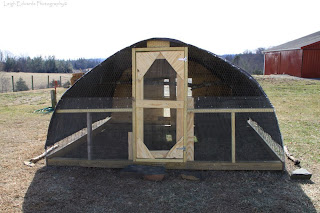


Yes – you can put more birds into a smaller space, but the more crowded your birds are, the more problems can occur, such as feather picking, over-breeding of one hen (if you have a rooster) and even cannibalism.


As for run space, 10 sq ft of ground space per LF chicken and 7.5 sq ft per bantam is generally sufficient. This also depends on your ability to allow your flock to free range. If your flock is able to free range all day, every day, then you may not need much of a run at all. Yet even for those who free range almost all the time, there still may be times your birds need to be confined on a pretty day. Perhaps there is a hawk that has decided to make a nest in a nearby tree and feast upon your flock, or perhaps a stray dog has been frequenting your property. It’s a wise thing to have a “safe place” for your birds to be outside when they can’t free range.

On the other hand, of your flock is rarely able to free range or only free range for a couple hours a day, you will want a bigger run. They need room to stretch their legs, scratch, find bugs and avoid other flock members when necessary. While the coop is like a chicken dormitory for sleeping, the run is the place they will be in for the majority of their active waking hours. 


Providing plenty of perches, stumps, a dust bath and other “chicken furniture” can go a long way to alleviate boredom and stress-related flock issues.


The last thing to consider when building your coop and run is just how addictive chickens are. If you can, build a larger coop than you think you will need… coops have a funny way of filling themselves up rather quickly!

 
Happy chickening!

- Leigh 
* 

Friday, March 8, 2013

Lead and Zinc– Hidden Dangers to Your Chickens


By Leigh -


When we hear about cases of lead poisoning, most of us think about children living in older homes with peeling paint or adults that work in industries where contaminated areas… we don’t tend to think about chickens. Unfortunately our backyard flocks may be at higher risk for lead poisoning than our children these days.  Worse yet, that lead can be passed to you (or to chicks) through your chicken’s eggs.

While most people living in older homes where lead paint may have been used (before 1978) have taken precautions, it can be easy to overlook chipping paint in an old shed or coop on the property. And those delicious-looking paint chips aren’t the only threat to our feathered flock of foragers. 


Many of us who keep chickens and try to live on the more organic side of life may also be avid hunters or anglers. Lead shot and fishing sinkers can pose a problem if they end up within reach of your curious and hungry birds.

Tire weights, lead pipes in your barnyard or coop plumbing, garden hoses, batteries, twist ties, products manufactured in certain parts of Asia and many household goods predating the 1970’s may also contain lead as well as many ceramic items. The soil itself can also be contaminated by past gasoline spills or landfill watershed.

In fact, the New York Times did an articlein October of this last year warning readers of findings of detectable lead contamination in the eggs of more than half of backyard chickens living in older neighborhoods in the Bronx, Queens and Brooklyn, NY. Some of the eggs tested averaged 11.5 micrograms of lead – almost twice the level the FDA deemed “acceptable” in 1993 for daily consumption by children under the age of 7.


So if you know there is a risk in the area your chickens are kept, what signs would you look for in your flock?

Well… with lower levels of lead contamination (say, from consuming a tiny paint chip or two) your chickens may not show any signs at all. This does not mean lead could not be present in the eggs. 


Fertile eggs from poultry contaminated with non-fatal levels of lead may die before or shortly after hatching, or produce live chicks with anomalies or deformities.


Poultry with higher contamination levels may exhibit the following symptoms:

Lethargy
Depression
Failure to grow or to maintain weight
Loose stools – greenish-black in color
Lack of balance
Disorientation
Inability to perch
Vomiting
Brain function disturbance
Loss of coordination
Loss of vision
Seizures
Inability to hold head straight
Death


Zinc, an even more prevalent substance these days, can also pose a poisoning threat to chickens. Zinc is present in galvanized feeders and in cage wire. While my personal choice would be to not use a galvanized pan or feeder for foodstuffs (and especially not for Fermented Feed), it is still generally safe to use galvanized wire… provided you do not leave any small clipped-off bits about where birds might ingest them.

Other coop-building and construction items like nails, washers and nuts may be produced with high zinc content, and US pennies minted after 1983 are 95.7 percent zinc. By nature, birds including chickens are attracted to shiny items, and because chickens spend much of their day searching the ground for interesting things to eat, small washers and wire bits may become a quick meal.


Signs of zinc poisoning in chickens include:

Loss of appetite / weight loss
Feather picking
Shallow breathing
Depression and lethargy
Weakness and shaking
Loss of balance
Diarrhea (in advanced cases stool may appear black and tarry)
Vomiting
Kidney, liver and pancreatic anomalies
Anemia
Death

Your best defense against heavy metal poisoning in your flock is to avoid playing too much AC/DC, Metallica or Black Sabbath in the coop.

Oh wait… that’s not right.

No – what I meant to say is that your best defense against heavy metal poisoning in your flock is knowledge. Having an awareness of potential dangers and keeping your eye out for areas on your property that could pose a danger to your birds is paramount.
If there is an area of known danger, do what you can to keep your birds away from it. Check old buildings for chipping paint, fence off areas where old motorized vehicles may have been sitting for long periods of time and keep hardware and fishing tackle away from your flock. Avoid exposing galvanized feed containers to the elements and pick up every last lucky penny you come across so your chickens don’t try to do it for you.

If you live on any land that has been occupied for many years, land that is near any kind of manufacturing plant, mine or land that has been used for dumping, consider having your soil tested.

And finally, keep an eye on your birds and be aware of their normal behavior so you can spot it if any seem “off.”

What can you do if you discover your birds have elevated levels of heavy metals? One can either cull these birds, or if you are willing to go to lengths to save them, chelation therapy can work to draw heavy metals out of the bird(s).

It would also be advisable to have your family tested if you have been eating the eggs of birds with high heavy metal levels.

Wishing everyone a great weekend!


- Leigh
*