Showing posts with label behavior. Show all posts

Tuesday, May 14, 2013

From Brooder to Flock Member - Integrating Chicks Into The Flock


How do you integrate your new chicks into your existing flock? Here’s what a few of us had to say on the subject:

Justine of Les Farms Says:

I integrated by having a run with little holes along the bottom just for the babies. They could get in and out, and the older birds could not get in (other than the Silkies - which was fine by me). 


It wasn't pretty, but it worked.. it worked really well.


This is on the outside. Chicks came through the holes and free ranged early.


Vicki Says:

My situation is different than most. I usually have broody's raising chicks so the flock is used to seeing chicks running around. I do not confine in a sense that most do.

Yes - I also brood chicks in a brooder.


When it is time to go outdoors… they go with the big birds.


They can get out of the building and they can get out of the fencing, but larger birds can't get in.

Then they graduate to another building when the next group comes.


They have access to the whole yard, yet can't free range yet. You have to be a laying adult and have the mental capacity to avoid predators.


The doors are kept open and all ages co-mingle all day long. I have about 20 food stations and 4 watering stations. My chicken yard looks horrible and messy, but it works for me. The adults are gone for most of the day eating out in the pastures, and the only ones inside the fencing are juveniles and babies. They all run through the 1/4 acre yard surrounded by a 7 foot high fence. I have 3 smaller fenced in side area's just in case I need to confine. We are presently working on two more. Next year I will have to confine more breeds to collect eggs and ship chicks. I added BCM to the Cuckoo. I also added the two varieties of Wyandottes.

Leigh Says:

While I prefer to have broody hens hatch and raise my chicks, it simply isn’t always possible. Hens don’t tend to go broody on command, and when they do go broody, they often all go broody at once. 


I hatch chicks throughout the season, and when I don’t have a broody, I have to use a brooder (mine is a large Rubbermaid container). When it is time for the chicks to start venturing outdoors, I set up my chick play yard. 
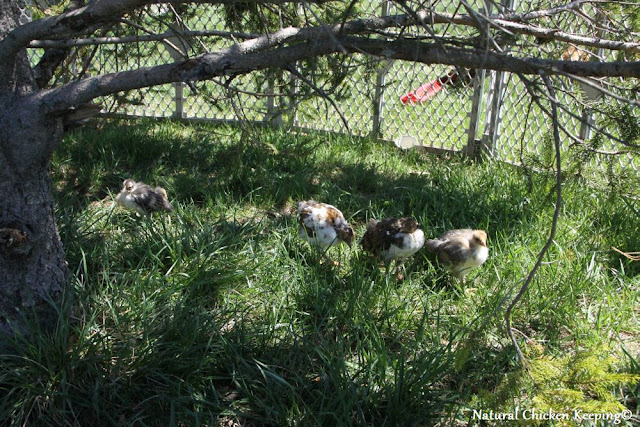

As the mother of 3 human children, I happened to keep 2 collapsible plastic outdoor playpens. They snap together to make one large yard which I set up under a big pine tree in the middle of the chicken yard. It makes the perfect cover to hide the chicks from aerial predators, and to deter my older flock members from jumping in to join the chicks.

 
This way my chicks can see and safely “meet” the older chickens though the plastic panels.

When I feel the chicks are old enough to fend for themselves (or run away fast enough) I let them loose as the flock free ranges. This can be a tough time because the older chickens will peck the little ones. Interestingly, I find it is most often the lowest chickens in the pecking order that are the worst about picking on the babies. I think it’s because finally these older chickens feel they aren’t on the bottom any more, and they want to keep those babies lower than they are on the pecking order.


Regardless of whether a chick is raised under a broody or in a brooder, they all have to go through a period of time where they establish themselves within the flock. This is the hardest time for us as humans to watch. Chickens are bullies - - but if we constantly intercede, the chicks will never become part of the flock. These are the times we have to stand back, plug our ears and not watch for a bit and let nature handle it.


During this intermediate phase, I allow all the chickens to free range together, but I keep the chicks in a large parrot cage inside the coop at night. I don’t like confining the flock in a small space together when there is still discourse. After a few weeks in separate digs (where they can all still see each other), the growing chicks are usually ready to perch with the older ones. In fact as I write this, two of my 9-week-old Swedish Flower Hen chicks are perching right up with the older flock members in the coop. 

So tell us - how do you integrate your chicks into the flock?

*

Thursday, May 9, 2013

How Do Chickens "Do It?" Chicken Sex Explained


Well this wasn’t the post I had planned on doing today, but when I trotted outside with my camera to capture some artistic chicken shots on this glorious day, I was treated to a real lens full. Compliments of my Swedish Flower Hen rooster (yes – that is an oxymoron, but the capitalized part is the actual breed name) and one of his Swedish Flower Hen… hens, I found myself with the material for an educational course on the birds and the bees… with an emphases on the birds.

You know? This may seem in rather poor taste to post all of this, but if you are reading this blog, chances are you live on a farm or farmette, or at very least you have or want chickens. I think those of us who are farmers or farmers at heart realize that animals aren’t exactly shy about what (or who) they do or where/when they do it.

(Photo source unknown, but clearly brilliant!)
 So please consider this a warning. If you are easily offended or embarrassed, 

Stop Reading NOW!


*****************


If you are still reading, I will assume that you will not be offended or call me out for posting chicken porn on this blog. Further, I will assume you are either curious about how eggs get fertilized, or you simply can't live without knowing how I am going to approach this delicate subject in such a public manner.


As the mother of 3 children, it would be all to easy to start out with, "When a daddy chicken loves a mommy chicken very, very much..." 

But you know? We're all grownups here. These are chickens, not humans, so let's keep it real. 

It all begins with a hormonally-charged rooster looking for all the world as if he is using Joey's line from the sitcom Friends... "How you doin'?"


Then the Fabio side of Mr. Roo (his name is Gunnar) kicks in for the foreplay. If he could speak, I think it might sound something like: "Hello very fine lady. Do you see the lovely and flamboyant dance that I do just for you. I have lowered my shockingly well-formed wing so as to allow you to see my beautiful feathers. You are impressed, no?"


"Are you not paying attention to my amorous advances, sexy lady? Do you not think me divine?"


"Shall I share my awesomeness with you?"


And here, you can practically hear Astrid's exclamation of "Ooofff" as Gunnar takes a sudden and rather clumsy leap onto her back and balances with one foot on either of her shoulders.


The act that follows takes the balance and skill of Tom Cruise's character in Mission Impossible as he navigates some ridiculously unrealistic obstacle course of deadly laser beams that we all know were electronically added in during editing. (As an aside, I initially spelled "obstacle" wrong and my spell check wanted to change it to "obstetrical." Hmmm... very insightful for my little HAL 9000.)
"Watch as Gunnar delicately navigates this obstetrical course..."

Sometimes Gunnar uses his wings much like a tightrope walker uses a balance pole. Hey - it takes skill to stand on someone's shoulders while having "relations" with them... not that I would know from experience.. but... ahem - moving right along...


The above photo that captured the actual 2 seconds where the "home run" happened.

Excerpt from the post Chickens, Eggs, Fertilization, Reproduction and Other Insider Information:


"When a rooster mates with a hen, he mounts her and, standing on her back, lowers his cloaca (vent) and the hen inverts her own cloaca to meet with his. There is no penetration, but the sperm packet released by the male is taken into the hen's cloaca or vent. From there the sperm makes its way to the infundibulum where it awaits the release of an ovum. Sperm can live in the infundibulum for more than 2 weeks."

Yeah - about 2 seconds is all the splendor in the grass that hen can expect.

Chicken folks will call this part "head-skating", "shoulder-surfing" or just "mating."
(And I call this postition, "The Vulture" he whispered softly into her ear as he fell off her back.)

That's right... shake it off!

A quick, post-coital snuggle...

"Quick! Act like nothing happened! Here comes one of my other wives!"

"I'll call you... "
And then comes the egg - though it can take a few days for eggs to be fertile after the first mating of a hen and roo. Also, eggs can be fertile for up to 3 weeks following the last 2-second romantic encounter between birds.


Even hens without roosters in the yard can go broody, but of course only fertile eggs will hatch.

"Look at me when I'm screaming at you, Mr.! First I push about a dozen objects larger then my own head out of my cloaca, and then I have to SIT here for 21 days! Did you HEAR that? Twenty-one days... while you... what? While you're off doing the wing-dance for that hussy, Ginger!"

And then come chicks!


And that, my friends, is where baby chickens come from!


***

From The Farm Blog Hop 

Thursday, April 18, 2013

How Much Coop and Run Space Do I Need?


By Leigh -


Quick answer:
Coop:

  • 4 square feet (sq ft) of floor space per Large Fowl (LF) chicken
  • 3 square feet of floor space per Bantam chicken
  • 1 square foot of ventilation per 10 sq ft of floor space

Perch Space:

  • 12 inches of perch space per LF chicken
  • 9 inches of perch space per Bantam chicken

Perch Type:

  • Perches should be positioned at least 12” to 18” away from the wall for head/tail space.
  • Chickens need a minimum of 18" to 24" of head space above the perch. Remember - they have to fly up there and you don't want them banging their heads each time they jump for the roost!
  • 2”x2” boards with the edges rounded off may be used for bantam breeds
  • LF do best roosting on the 4” side of a 2”x4” with rounded edges.
  • Natural branch roosts may also be used (minimum diameter of 3”-4” (but not all types of wood are healthy for chickens, so check prior to using.)

Nest Boxes:

  • 12”x12” is the standard size for nest boxes, but your chickens won’t mind slightly smaller or larger boxes (provided they fit comfortably).
  • Minimum of 1 nest box for every 3 laying hens

Run:

  • 10 Sq Ft of ground space per LF chicken
  • 7.5 Sq Ft of ground space per Bantam chicken


It can be confusing for those new to chickens to wade through the variety of information on proper coop and run square footage for their flock. Manufacturers selling small “doll house” coops often tout their structure as being able to house up to “X” amount of birds… and often those numbers are misleading or not appropriate for the birds or the buyer’s needs.

In general, you should have a minimum of 3-4 square feet of floor space for each large fowl (LF) bird in your flock and 2-3 square feet for bantam breeds.

Note I specify “floor space.” What this means is that it doesn’t really matter how tall your coop is – just how wide and how deep. Thus, a 4’x4’ coop that is 3’ high can house just as many birds as a coop that is 4’x4’ and 7’ high. 


During the day, chickens spend most of their time on the ground. In the event of bad weather when the chickens don’t want to leave the safety of their coop, crowded floor space may cause tension and bullying.

Imagine two scenarios. In the first, you are stuck in a standard-size elevator with 10 people… and one of those people a bully who has decided he simply does not like you. The more bored or stressed he gets, the more that bully picks on you. Yikes, right?

Now imagine you are with those same 10 people in a diner. It is still a limited space, but if you stay in one corner of the diner eating your food, reading your book and minding your own business, the bully is less likely to move from his seat to pick on you. You can also move away if he comes near. More space means it will be harder for him to corner you.


Yes – you can put more birds into a smaller space, but the more crowded your birds are, the more problems can occur, such as feather picking, over-breeding of one hen (if you have a rooster) and even cannibalism.


As for run space, 10 sq ft of ground space per LF chicken and 7.5 sq ft per bantam is generally sufficient. This also depends on your ability to allow your flock to free range. If your flock is able to free range all day, every day, then you may not need much of a run at all. Yet even for those who free range almost all the time, there still may be times your birds need to be confined on a pretty day. Perhaps there is a hawk that has decided to make a nest in a nearby tree and feast upon your flock, or perhaps a stray dog has been frequenting your property. It’s a wise thing to have a “safe place” for your birds to be outside when they can’t free range.

On the other hand, of your flock is rarely able to free range or only free range for a couple hours a day, you will want a bigger run. They need room to stretch their legs, scratch, find bugs and avoid other flock members when necessary. While the coop is like a chicken dormitory for sleeping, the run is the place they will be in for the majority of their active waking hours. 


Providing plenty of perches, stumps, a dust bath and other “chicken furniture” can go a long way to alleviate boredom and stress-related flock issues.


The last thing to consider when building your coop and run is just how addictive chickens are. If you can, build a larger coop than you think you will need… coops have a funny way of filling themselves up rather quickly!

 
Happy chickening!

- Leigh 
*